Questioning the Raven
The RavenQuestioning the Raven is the central verbal action through which the narrator converts an unexplained visitor into an apparent oracle. The exchange begins with wonder at a Raven that can speak, but its repeated answer, “Nevermore,” gradually acquires force as the narrator directs increasingly intimate questions toward it. What first appears to be a test of the bird’s identity becomes an attempt to determine whether grief can be relieved, whether spiritual consolation exists, and whether Lenore can ever be recovered. The interrogation therefore changes the Raven from an external disturbance into the instrument through which the narrator confronts the permanence of loss.
Identity and Immediate Setting
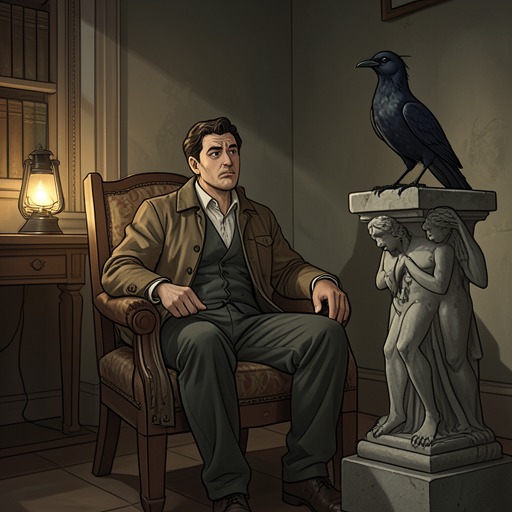
The questioning takes place after The Raven enters through the window and perches above the chamber door on a bust of Pallas. Its entrance is formal but unexplained: it steps into the room as a “stately Raven of the saintly days of yore,” makes no obeisance, and assumes a position above the narrator. The bird’s grave decorum briefly beguiles the narrator’s sad fancy into smiling, allowing the encounter to begin in a register of grotesque amusement rather than immediate terror. Yet the elevated perch and the bird’s unreadable bearing already give it a position of symbolic authority within the chamber.
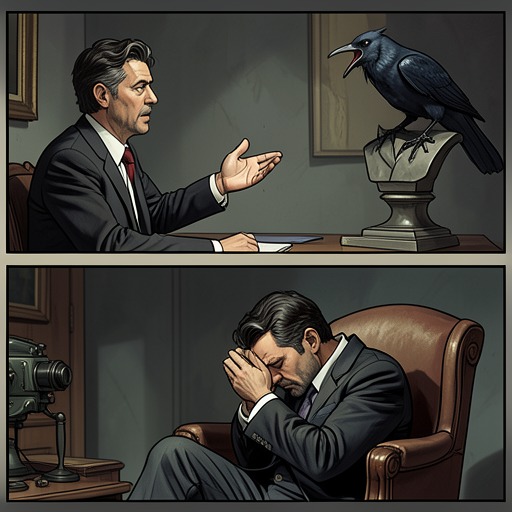
The narrator’s first direct questions combine mock ceremony, suspicion, and a desire for knowledge. He addresses the bird as a “Ghastly grim and ancient Raven” and asks for its “lordly name” on the Night’s Plutonian shore. The question treats the animal as a traveler from a distant, possibly infernal region, while the elaborate address also tries to impose a human system of naming and rank upon it. The Raven answers, “Nevermore.” The response appears at first to have little meaning or relevance, and the narrator marvels that such an “ungainly fowl” can discourse so plainly. This tension between the bird’s animal form and its apparently purposeful language establishes the interrogation’s governing uncertainty: the Raven may be only a speaking creature, or it may be something far more ominous.
From Curiosity to Emotional Inquiry
The narrator does not abandon the exchange after receiving an apparently meaningless answer. Instead, he interprets the Raven’s speech as a learned verbal habit, imagining that the bird may have acquired “Nevermore” from an unhappy master whose misfortunes made the word a recurring burden. This explanation temporarily reduces the Raven’s authority by making its answer mechanical rather than prophetic. At the same time, the narrator’s attention to repetition gives the word a new power: a phrase learned through suffering can become the sound that organizes another sufferer’s thoughts.
The questioning becomes more deliberate as the narrator takes a cushioned seat and positions himself before the bird, the bust, and the door. This arrangement turns the room into a scene of examination. He attempts to link what the Raven means, what it “croaks,” and what the narrator himself has suffered, while the bird remains physically still and verbally constant. The narrator’s earlier strategies for managing distress—reading, delaying the morning, repeating that the knocking means “nothing more”—have not ended his sorrow. The interrogation now becomes another method of emotional regulation, but unlike his earlier explanations it does not restore control; it gives the repeated answer a wider field of application.
The Raven’s silence outside its single response is crucial. It offers no explanation, qualification, or alternative, so the narrator supplies the connections himself. The bird’s meaning expands according to the questions asked of it. A word that initially seems irrelevant becomes a reply about bereavement because the narrator places his loss before it. The questioning thus reveals less about any demonstrated intention in The Raven than about the narrator’s compulsion to make the bird’s fixed utterance answer the deepest questions of his own mind.
Questions of Consolation and Forgetfulness
The interrogation reaches its first explicitly therapeutic form when the narrator appeals to supernatural relief from memory. He cries, “Wretch,” and declares that God has sent the bird, through the Angels, to offer “Respite—respite and nepenthe from thy memories of Lenore.” He then urges the narrator himself to drink the forgetfulness promised by nepenthe. The address is rhetorically unstable: although the line speaks to the bird, its demand also sounds like a command directed inward, as if the narrator were trying to persuade himself that divine intervention can suspend grief.
The Raven answers, “Nevermore,” and the reply destroys that imagined remedy. The word denies not merely the possibility of forgetting but the hope that the encounter has been sent as benevolent relief. The narrator’s appeal has moved from an inquiry about a name to a plea for release from the memory of Lenore; the unchanged answer makes the bird appear both indifferent to the distinction and terrifyingly exact in its effect. The narrator’s sorrow is not replaced by consolation. Instead, the attempted cure becomes another occasion for confirmation that the past cannot be escaped.
Prophecy, Faith, and Reunion
After the failure of the appeal to nepenthe, the narrator explicitly reclassifies the bird as a possible supernatural speaker. He calls it “Prophet!” and “thing of evil,” while still allowing that it may be either bird or devil. He asks whether a Tempter sent it or whether a tempest tossed it ashore. These alternatives preserve the encounter’s ambiguity: the Raven may be an agent of evil, a storm-driven animal, or a sign interpreted under the pressure of grief. The narrator’s language grants it prophetic status even as he condemns it.
The next question asks whether there is balm in Gilead. The appeal invokes the possibility of a healing substance associated with divine or sacred consolation, but the narrator asks for it within a home haunted by Horror and describes himself as desolate yet undaunted. The question is therefore both theological and personal. It asks whether suffering has any remedy while also testing whether the Raven can confirm a world in which spiritual healing remains available. The answer, “Nevermore,” closes off that possibility with the same formula that had already denied forgetfulness.
The final question in the interrogation turns from relief in the present to reunion beyond the present world. By the Heaven above and the God shared by the speaker and the bird, the narrator asks whether, in the distant Aidenn, he will clasp Lenore, the rare and radiant maiden whom the Angels name. The question gives the Raven a final opportunity to affirm hope: not the temporary easing of memory, but the possibility that love may survive death. The answer is again, “Nevermore.” In this context the word becomes the most devastating version of the refrain, denying the anticipated reunion and transforming theological uncertainty into emotional finality.
Escalation and Narrative Consequences
The interrogation’s structure is an escalation from identification to healing to salvation. The first question asks who the bird is; the next major questions ask what can be done about grief and whether the dead can be encountered again. Each question reaches farther than the last, and each receives the same answer. The repetition creates a stark contrast between the narrator’s increasingly elaborate language and The Raven’s verbal poverty. The narrator produces images of Plutonian shores, divine messengers, nepenthe, Gilead, Heaven, and Aidenn, while the bird offers only one word. Yet the narrowness of the Raven’s vocabulary makes that word seem inexhaustible, because the narrator repeatedly places new hopes before it for rejection.
The questioning also reverses the apparent balance of power. At first the narrator explains the Raven’s answer as a memorized phrase with little relevancy. Later he treats the bird as a prophet whose utterance can settle questions of spiritual healing and eternal reunion. The Raven need not argue, persuade, or move. Its authority grows through the narrator’s own continued questioning, and the narrator’s attempts to force a meaningful answer become the mechanism by which “Nevermore” dominates the scene.
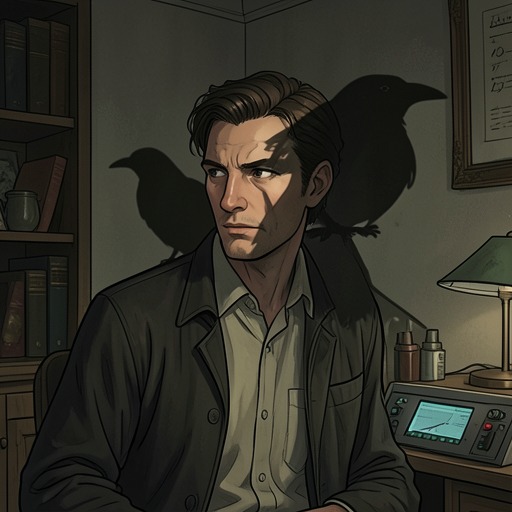
By the ending, The Raven remains on the pallid bust of Pallas above the chamber door, its eyes seeming like those of a demon dreaming while the lamplight throws its shadow across the floor. The interrogation has left no factual explanation of the bird’s origin and no consolation for the narrator. Its decisive consequence is psychological: every effort to obtain relief, certainty, or reunion has been absorbed into the same refrain. The narrator’s soul remains within the shadow cast by the bird, so the questioning ends not with knowledge that resolves the mystery but with a permanent condition of grief governed by the Raven’s refusal to say anything other than “Nevermore.”